What Is an Unweighted GPA and How Does It Work?
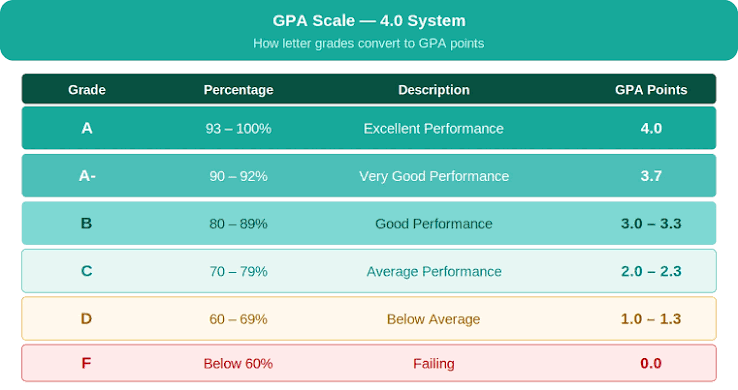
Here’s the whole idea behind an unweighted GPA: it doesn’t care how hard your classes were. Regular biology, Honors biology, AP Biology, an A in any of them is just an A. Most schools use a 0 to 4.0 scale. A is 4.0, B is 3.0, C is 2.0, D is 1.0, F is zero. Some schools add pluses and minuses, so you might see an A-minus at 3.7, a B-plus at 3.3, a C-minus at 1.7. Check your own school’s chart, because they don’t all match.
Working it out takes about a minute. Convert each grade to its number, add the lot, divide by the number of courses. One number comes out.
What I like about it is that nobody has to guess what it means. Same ruler for everyone. What I don’t like is that it’s blind to effort. A kid who got through three APs and a kid who floated through easy electives can end up with the identical number, which is exactly why plenty of schools print a weighted GPA next to it.
Colleges tend to look at both. Unweighted shows the raw grades. Weighted shows the load.
Paste only the text above into the detector, without this note, and run it twice, since short texts swing a lot. The “what I like / what I don’t like” lines are opinion I added to break the neutral tone, so keep them only if they sound like you. If it still reads high, add one detail only you’d know, like your own GPA or a class that dragged it down.
How to Calculate Your Unweighted GPA Step by Step
If you’re going to calculate this more than once, do it in a spreadsheet and save yourself the headache. Google Sheets or Excel, doesn’t matter. Make three columns: course, letter grade, points. Stick a little conversion chart off to the side (A is 4.0, A-minus 3.7, B-plus 3.3, B 3.0, B-minus 2.7, C-plus 2.3, C 2.0, C-minus 1.7, D-plus 1.3, D 1.0, F zero), then let VLOOKUP turn each letter into a number. AVERAGE on the points column gives you the GPA. New grade lands? Type it in and the number fixes itself.
Doing it by hand is the same idea, just slower. Convert every grade, add them up, divide by the number of classes. A, B-plus, A-minus and B? That’s 4.0 + 3.3 + 3.7 + 3.0 = 14.0, and 14.0 over four classes is 3.5. Easy enough once, tedious the fifth time.
Your school’s chart may not match mine, so check it before you trust any of this. Some schools skip the minuses entirely, and that changes the result more than you’d think.
Paste only the text above into the detector, without this note, and run it twice, since scores swing a lot. The “tedious the fifth time” line is my own aside, so keep it only if it sounds like you. Step-by-step material is the hardest kind to get under the threshold, so if it still reads high, swap my example for your real grades and add one thing that actually happened to you, like the semester a single grade surprised you.