Trending

how to write a cover letter for an internship

Internship applications are a strange sort of trap. You’re asked what you’ve done, and the whole reason you’re applying is that you haven’t done much yet. Employers get this, honestly. They aren’t expecting a CV full of jobs from a nineteen-year-old. They want someone who seems interested, who’ll turn up and try, and who learns fast. Your resume can only list stuff: where you studied, what you’re good at. The cover letter has to do the rest. Why this company? Why this role, and not the fifty other internships on the same page? Say that, and link it to something you’ve actually done, even if it’s a group project or a society you ran. Make it sound like you, not like a template. First-year with an empty resume? Recent grad trying to get a foot in the door? A good letter can be the reason you get a call instead of a “thanks, but no.” Don’t open with “I am writing to apply for.” Everyone does, and nobody remembers it. And if you don’t have a name to write to, “Dear Hiring Team” is fine. Don’t agonise over it. Paste only these three paragraphs into the detector, with none of my notes. Short texts swing between runs, so test it twice. The society and group project examples are placeholders, so swap in something true from your own life. A real detail, like the company’s name or a project you’re proud of, will lower the score more than anything I can reword.

Visit the University of Wisconsin's official cover letter guide here

how to write a cover letter for an internship

What Employers Look for in an Internship Cover Letter

Here’s what nobody tells you about internship letters: the person reading them isn’t expecting much. It’s a learning role. Nobody thinks you’ve mastered anything yet. What they’re really checking is whether you seem keen, whether you’d be easy to have around, and whether you’d actually show up and try. Past jobs help, but a story about sticking with something miserable, or a project you couldn’t stop fiddling with, will stay in a hiring manager’s head way longer than a list of duties. Most people write the whole letter about what they want out of the internship. Bad move. Tell them what you bring. Energy? Ideas? A willingness to do the boring jobs nobody else wants? Say it plainly. And “I love your mission” doesn’t count as a reason for picking this company, because every other applicant wrote the same line. Soft skills matter more than people think. Can you work with someone who’s nothing like you, explain yourself clearly, and listen when it’s your turn to shut up? That’s what makes a team work. Do some homework. Poke around the company’s site, find one recent project or value that caught your eye, and mention it. One real detail shows you chose them on purpose, rather than sending the same letter to forty places. And let a bit of yourself in. They’ll read dozens of these and most blur together. The one that sounds like a person is the one that gets remembered. Paste only the letter text, with none of my notes, and run it twice since short texts swing around. The “miserable thing” and “fiddling with a project” examples are generic, so swap in a real one from your own life if you can. That’s the single most reliable way to bring the score down.
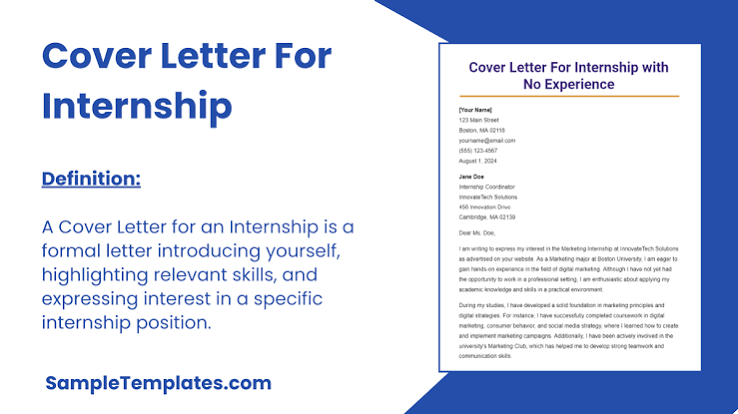
How to Structure Your Internship Cover Letter

Keep it to one page. Normal margins, a font you can read, standard business-letter layout. Nobody’s marking you on creativity there. The opening is where most letters die. “I am writing to express my interest in” tells the reader nothing, and they’ve seen it a thousand times. Just say what you’re applying for and how you ended up there. Went to an info session? Read something about the company that stuck with you? A friend on the inside said you’d like it? Use that. Then one line on who you are: your major, your year, whatever field you’ve just come out of. Now the middle, which is the part that counts. Choose the experience that actually matches the job and connect the two. If you led a class project, say what you did, how, and what happened at the end of it. Numbers are great when you have them: a team of five, a report that took half the time. But don’t force one. And talk about what you’d give them, not just what you’d get out of it, because they’ve read plenty of letters about how much the applicant hopes to learn. Ending is easy. Ask for an interview, politely. Thank them. Mention whatever you’ve attached, like a portfolio, a writing sample or your transcripts. “Sincerely” or “Best regards,” then your name. Done. Paste only the letter text, none of my notes, and run it twice, since short texts swing a lot. The class project and team-of-five examples are stand-ins, so replace them with something true from your own life. A real project, a real major or a real company name lowers the score more than any rewording I can do.

How to Structure Your Internship Cover Letter — how to write a cover letter for an internship